
You wouldn't crack open a bottle of Scotch to celebrate a bridal shower. And you wouldn't pour shots of tequila for a quiet evening of journaling. Alcohol drinkers have always known, instinctively, that different drinks produce different vibes. Cannabis is no different — it just hasn't had the vocabulary to explain it. Until now.
The Drinks Analogy Nobody Talks About
Think about the last time you had a few glasses of wine on a weeknight. It softens the edges of the day. Your shoulders drop. You're present, a little sleepy, warm. Now think about a round of margaritas at a rooftop bar — the energy is completely different. Loud. Social. Giggly. Electric.
Same drug (ethanol), wildly different effects. Why? Because the compounds around it — congeners, botanicals, fermentation byproducts — interact with your neurology in distinct ways. And the context amplifies everything.
"Your body doesn't experience molecules in isolation. It experiences the whole cocktail — chemistry, context, and emotional readiness."
— The science of mood-altering substancesCannabis works the same way. Different strains have different terpene and cannabinoid profiles, and those profiles produce genuinely distinct emotional experiences. An Indica-heavy strain before bed is your glass of Burgundy. A bright Sativa before a creative session is your espresso martini. A balanced Hybrid is your perfectly crafted Old Fashioned — complex, nuanced, dependable.

Meet the Spirits of Cannabis
Let's break it down. There are three primary categories of cannabis, and each maps cleanly to a corner of the drinks cabinet.
The analogy isn't perfect — no analogy is. But it gives people who are already emotionally literate about alcohol a shortcut into understanding cannabis. And emotional literacy is exactly the point.
The Science: Plutchik's Wheel Meets Your High
In 1980, psychologist Robert Plutchik mapped the entire landscape of human emotion onto a single, elegant wheel. Eight primary emotions — arranged in opposing pairs, varying in intensity — like a colour wheel for feelings.
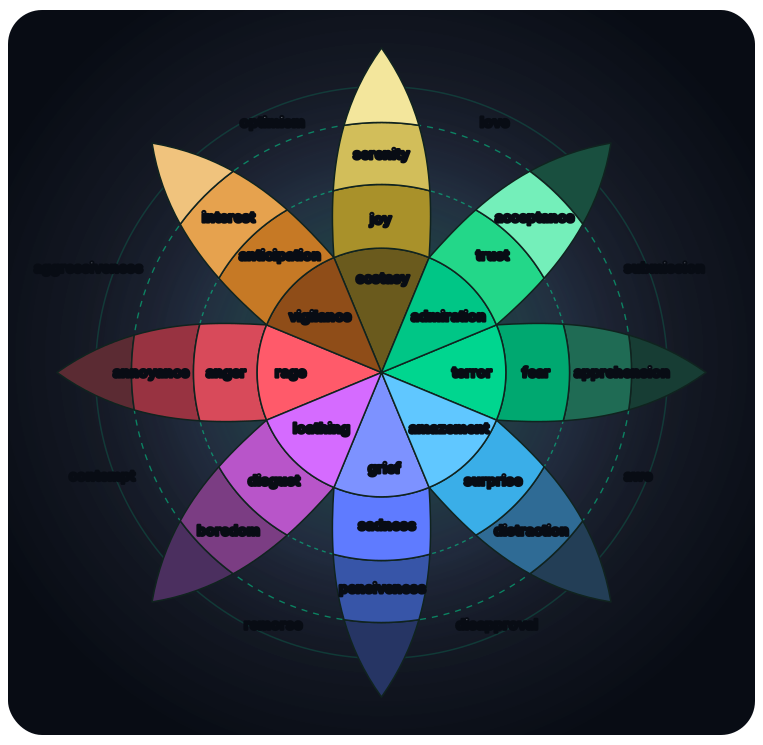
Plutchik's Wheel of Emotions (1980) — eight primary emotions in opposing pairs, varying in intensity. The darker the shade, the more intense the feeling.
The eight primaries, in opposing pairs:
Here's what's remarkable: these eight primaries map almost directly to the documented effects of cannabis strains. The Alfy database contains thousands of strains scored across 33 emotional dimensions — and when you overlay those scores onto Plutchik's wheel, the clusters are unmistakable.
Strains that score high on Happy + Euphoric + Uplifted sit in the joy–trust arc of the wheel. Strains strong on Relaxed + Sleepy pull toward the sadness–acceptance range (the quiet, inward emotions). High Energetic + Creative strains light up the anticipation–joy quadrant. The wheel isn't just a metaphor — it's a map.
Emotional Literacy: Why Vocabulary Matters
The richer your emotional vocabulary, the better you can predict how an experience will affect you — and the better you can communicate what you actually want. This is what EQ researchers call self-awareness: the ability to notice the state you're in, name it accurately, and understand what produced it.
Most people describing their cannabis preferences use the crudest of terms: "I want something relaxing." But relaxing on Plutchik's wheel could mean anything from serene acceptance to sleepy withdrawal to the quiet joy of contentment. Those are very different experiences — and they're produced by very different strains.
"Emotional literacy is the foundation of self-awareness. And self-awareness is the foundation of any tool that's meant to serve you — not just satisfy you."
— Alfy's design philosophyThe more precisely you can name what you're feeling — or what you want to feel — the more accurately Alfy can match you to the right strain. This is why the app is built around emotional language, not just categories.
Strains in the Wild: Real Emotional Profiles
Let's put this into practice. Here are four strains, described through the lens of their emotional profile — not just their genetic heritage.

The Combinations: Emotion Mixing 101
Plutchik didn't stop at eight primaries. Just as primary colours mix to create the full spectrum, primary emotions combine to create more complex states. Joy + Trust = Love. Fear + Surprise = Awe. Anticipation + Joy = Optimism.
Strains work the same way. The most sought-after effects aren't single-emotion experiences — they're combinations. The feeling of being "in flow" (creative + focused + slightly euphoric) is a tertiary blend on Plutchik's wheel. And there are strains — like Bruce Banner, Gelato, or Mimosa — that hit that exact combination reliably.
This is why Alfy uses a multi-dimensional scoring system. A single "Happy: 80" score doesn't tell you enough. But "Happy: 80, Creative: 75, Focused: 65, Relaxed: 40" tells you exactly what kind of high you're walking into — and whether that matches what you need right now.
So What's the Right Strain for You?
The answer starts with a question you might not be used to asking yourself: What do I actually want to feel? Not what you want to do, not what situation you're in — what emotional state are you aiming for? Quiet contentment? Buzzing creativity? Warm social ease? Deep physical rest?
Once you can name it — with the precision of someone who's thought about Plutchik's wheel, or just with the emotional literacy of someone who knows their drinks — the right strain becomes obvious. The science takes over from there.
Alfy was built to bridge that gap. To take your emotional vocabulary, however rough or polished, and translate it into the exact strain that fits. No guesswork. No generic "just try an Indica" advice. A recommendation as precise as your feelings.
🌿 Find Your Match
Tell Alfy how you're feeling — and get a recommendation grounded in the science of emotional literacy.
Try Alfy Free →